Of note because of director Bob Clark, of A Christmas Story fame, and as a proto-slasher movie, as well as its cast: Margot Kidder, Olivia Hussey, Andrea Martin, Keir Dullea, John Saxon. It's photographed really well, that's truly great about it, lit well. The shots are set up well, and there's a decent direction to that, rapt, so Clark gets credit for that as well as cinematographer Reginald H. Morris. And it's trying to be about mood, atmosphere. But the script, in B-movie and also proto-slasher form, is given to jags of humor that are mostly goofy, what it does provide as action or dialogue, and Clark doesn't handle that very well, like the scene in the police dept with Margot Kidder and the cop. Some of the music is more sophisticated, more minimal.
Somewhat like My Dinner with Andre, this is a kind of rudimentary presentation of a dinner party, following the progression of one evening. As a movie giving us a recreation of 1904 Dublin, it has to do more than James Joyce's story to be realistic, but director John Huston gives us, if not quite documentary like, a simple syntax of showing. At one point there is a cutaway to details on tables, photos and adornments, and it's not setup, but follow-on and in passing. The depiction follows the spirit of its subject(s), but it's also contributing to it. The lighting isn't very good (cf. Black Christmas), too TV studio shiny and thus anachronistic with the production design, but apart from that, it catches us up in the dinner party which then has its turn with the final scene, what musing the evening has set off with Angelica Huston's character. It might be a surprise, a change of tone, but it's also part of the flow, the way the distant, the past is part of our moment, too.
Directed and co-written (with Enda Walsh and Alice Birch) by Lynne Ramsay, who also directed Ratcatcher, Morvern Callar, We Need to Talk About Kevin and You Were Never Really Here, this similarly, especially as the latter three, gives a sympathetic depiction that's also moody and difficult, but grinds the gears. It's laboring the point of not making a point, going too far in the opposite direction of any attempt at explanation. It's a good role and performance for Jennifer Lawrence, despite the problems for that, too.
It doesn't get any points for a concept that's even less original than when it was the 1987 movie, but it has a drive that's also it's humor and vice versa, delivered by director Edgar Wright and best represented by his leading man Glen Powell.
A family brawl at Christmas. Royal. A Christmas court. It's bitchy and almost a camp version of history or Shakespeare, so there's fun in that, but along with some trendy flourishes of the day that are anachronistic in not quite the same humor, both the script and director Anthony Harvey's presentation lean to the stately drama enough to make it a weaker compromise. The sing-song way the characters, especially Henry II (Peter O'Toole) and Eleanor (Katharine Hepburn), comment their wiles to rise above them, defer, fall right into the very ploys and fighting, and repeat, can't be taken seriously.
It holds up the standard of its predecessors in general, if it lets down a little in the final third, where the convolutions become a bit of a blur, and there's at least one scene that strains for effect with the detective character Benoit Blanc on the organ and in the pulpit. As with Glass Onion, it gets in its sneaky comments on current matters -- not really sneaky what it says, but in the way the whole works to get to them. In another fun cast, interesting choices, Josh O'Connor proves a particularly great choice as the anchor character, apart, of course, from Daniel Craig's Blanc, who comes in later in very Columbo fashion.
28 Weeks Later (2007)
28 Years Later (2025)
The digital video of the day for the original, despite the aesthetic choice, looks worse with time and the progress of video. The sequel scarcely improved on that, but it's also notable for making more unrelenting turns with what seem like principle characters and actors. By the time we pick up with the third movie, after so many other zomboid outbreak apocalypse moves and series, this has become such a strange conflation of thriller straight face even through oddball grotesque, introspection, and off-key -- pretty much from left field -- parodic reference, it's a vein of its own. The music contributes to this, too. It's good and interesting in its own right, but its own intensity adds another kind of gravity to the mix.
Terrence Malick's ruminative tactic -- not to say "style," perhaps better to just say ruminating -- wasn't lacking complexity and even teeth in Badlands or The Thin Red Line, showing violence and pain mingled with idyllic, and even the way that these are not strangers or even causally unrelated in hearts and minds. The way it's progressed, and after Song to Song, where even the internal monologue has taken over more, and everything is more floaty, it's harder to avoid the sense of mopey reverie. The subject here proposes to give Malick something to bite into, and more pressing pertinence: the story of an Austrian conscientious objector under Hitler coming during Trump's first term in office, even before the more overt comparison now. But the subject doesn't distill the haziness. Think of the attack on the Japanese camp in The Thin Red Line, where even the elliptical method changed tone, but also gave a whole different kind of tone to battle and violence, and involved so much counterpoint; or even Nick Nolte's speech. In Malick's case, some scripted or more prosaic material, as far as movies go, gives an edge, a hard ridge to feel through, a stone path through the wispy garden.
This is notable in the history of computer graphics in movies, especially after Lord of the Rings for Peter Jackson, because of how much it used at the time. But after the manic gore ride of Dead Alive, this aims for the post-Spielberg horror comedy effects blockbuster, a la Ghostbusters, Beetlejuice, The Goonies, but is even more run-on and slambang. The constant gyrations and detours and swerves in the line of action might keep it from following the story you thought, but constantly setting up another showdown is tedious.
A movie that tries to be about the real life of movie people runs a greater risk of disingenuousness. Noah Baumbach as writer and director did so well with A Marriage Story, the evocation touching so many great reference points, making deft, poignant observations. By contrast, the story here seems more built up, concocted, aiming at the effect rather than at what it's observing. George Clooney's role and performance carry this most. The memory cutaways are formal, staged in a movie way, which isn't necessarily bad, but it's a different language, a more declamatory dramatization, and here it comes off a bit stilted. Nothing gives us Clooney's flush of real life, only assertions that he's having these realizations, genuflections. Again, by contrast, The Descendants made a more rumpled, vulnerable version of Clooney. Adam Sandler's role doesn't seem to be a good one for him at first, but he actually provides moments that have more evocative punch, especially a scene with Laura Dern where he's reacting to a revelation.
As a prime example of 80s movies, this is built on the principle of background noise, but more particularly it's built on the 80s fad of the red tinted sky, as seen in music videos and movies, the upper strip of the image like the way children color the sky, except red. This movie actually gives a reason for it with the plot despite how little it does to establish anything else. Striking images alternate with tepid, the sort of B-movie treatment that could be slack and self-conscious at the same time, like the bland formality of family photos. The interesting images, mostly of deserted Los Angeles look like entirely different photography, and are often oversaturated with the red tint. Later, some green lighting with some deep focus shots combine to make this a sort of Christmas color study, so you could use this as an 80s Christmas decoration in the background. If you can't bear the synth rock ballad soundtrack -- that won't let up but cuts in and out of songs and volume levels and whether they're in frame or out -- just turn off the sound. But there's only the mention of Christmas, as with anything else passing reference, some zombies, some terrorists, some government scientists, all in a soup of whimsical detachment with the big hair, 80s mane look, dancercise outfits, arcade games and teen sex, though also Robert Beltran, Mary Woronov and Geoffrey Lewis.
There's an interesting idea here, mixing Star Trek, 2001: A Space Odyssey, Silent Running and The Boys in the Band, with a bit of The Partridge Family or The Electric Company for decor, but the way it idles about everything at first, it seems more a reference to the ideas than an execution. By the time it starts to come together to engage us with the characters, there's a revelation party -- the occasion is also Christmas, so there's a bit of that backdrop, too -- that's as arbitrary and forced on us as on the characters, and then a more abrupt ending that leaves things all open without enough commitment to care. You could try this as a double feature with Night of the Comet for odd period piece Christmas background.
Though it's not the peak of ingenuity that Trouble in Paradise was, it's still a shimmering silver standard of what moving pictures could be even as theater. Samson Raphaelson's script, based on the Hungarian play Parfumerie by Miklos Laszlo, stretches effect in places -- the comeuppance of the philanderer, the revelation of the letter writers especially at the end -- but it's full of canny takes and touches, and even the main device of the letter correspondence remains pertinent today with Internet personals. Ernst Lubitsch makes it all glide, so that the banal and pathetic are part of the sparkle, too. Frank Morgan and James Stewart come off particularly well with more fine-tuned performances than usual. Stewart seems out of place at first, with others even having European accents, but he ends up making his character seem as homesy in Budapest as fictional American hometown. The more workday proportion, even grumpiness and frustration, make Stewart less melodramatic and he gives that an elegance. And on that note, you might want to try this as a switch on It's a Wonderful Life as a Christmas movie.
The superhero origin story of Mary Shelley's Frankenstein. Looks like a coloring book.
Juicy indulgence from the script by Robert Kaplow, who also wrote the novel Me and Orson Welles is based on, also directed by Richard Linklater. It's theatrical in a literary way, lots of prosey dialogue, and though its merits are more those of a stage play, Linklater does well to honor its cozy and cool. What makes it interesting is the way Kaplow treats the clash of culture, backstage gossip and off-stage opinion around a production of Oklahoma!, but it's also the intertwined snakes of broader culture, sweet and salty, the pleasure principle and the reality principle, credulity and sophistication. And the way he shows Lorenz Hart's negotiation of this through all the strands of his personal life also sets up Ethan Hawke for a standout performance, though the whole cast is great.
Of interest as Robert Altman's feature film debut -- he directed tons of television before this -- although, but also because, he got fired from the project. One of the reasons was overlapping dialogue. What became a main element of his style was at first seen as incompetence by the studio executives. Also of interest is the cast, James Caan and Robert Duvall working together, and later Altman actors Michael Murphy and Barbara Baxley, and note also Ted Knight. For a story about rushing the space program to land a man on the moon because of the race with the Soviets, it's fairly grown-up material from scriptwriter Loring Mandel (from a novel by Hank Searls), and handled in a mature way by Altman. Which is also to say boring for any wide popular success. Like Marooned of a couple of years later, movie audiences found that realistic drama in space was not fast-paced action.
It gets cute, which will please a wider audience, if not some Predator fans who want it to be badass. The original was fun because it worked as a twist on clunky commando movies, so having some sort of smarm or pop foil isn't new or necessarily a spoiler. Director Dan Trachtenberg gives it dash and even the less dry humor goes over better. It actually comes the closest to what I wanted to see in an Alien-Predator crossover, which is no humans, not even dialogue, like watching a nature film, thus it's a better crossover than the direct Alien vs. Predator editions, and certainly better than Alien: Earth, which is cute in a whole different, self-enamored way.
This movie tries to make way too much out of one basic stroke: sometimes one person, usually two people suddenly freeze as we hear growling, they turn slowly toward the camera, then cut to CG fluffed canine stalking face first looking considerably more like a wolf than a coyote with the villainous intent of a superhero movie. Maybe suspenseful once, becomes a bad effect for repetition alone, if not otherwise. So much wasted, including a good cast, with the premise of coyotes attacking Hollywood Hills homes.
The play is the source of the newspaper ethos and lots of newspaper cliches in American movies. Director Lewis Milestone gives it a dynamite visual plan, the way lots of early 30s movies were flexing the medium, often doing cinematic gyrations just for show, but the way it's run through, especially the acting, it's like a wind-up stage play machine.
His Girl Friday (1940)
This reworking of The Front Page provides a model of the difference, especially in Hollywood movies, between the rougher but more playful and inventive 30s and the button-down, polished 40s. For this material, Charles Lederer, working with Ben Hecht and Charles MacArthur's play, and director Howard Hawks, who had the idea to make Hildy Johnson a woman, tightened things up, cut out a lot of the milking, and gave it a smoother, less preachy bearing. It's the cinema as leaner theater. But the general tilt is back to the movies as a version of theater, saucier, less prim, a broader view, perhaps, but doing what directors like Renee Clair and Fritz Lang tried to prevent, which was the cinematic art becoming subordinate to sound and dialogue. The Hawks line of female role is that ambivalent state where so many qualities and abilities of women are accepted as commensurate with men, but no explicit cause for it is made, no call for any real change of convention, whether feminist or not. The Hawks main female character represents this, refers to it, but it's also a model of it. It cuts both ways. The movie title pushes the play with roles. Rosalind Russell's Hildy marches right into boss and ex Cary Grant's office, she's already part of this environment, and in some ways this movie is one of the best of the era for being more unassuming about it. But while it's not played so much as a capitulation here -- and there's some interesting role reversals with Ralph Bellamy, and the male Hildy of the original is also giving it up for marriage -- there are so many cases of strong lead women characters in Hollywood films wilting or buckling or surrendering in the end so as not to be a threat to conventional roles, as supposed by the purveyors.
The Front Page (1974)
Billy Wilder didn't like remakes, but his decision to make a version of this set in its original time period makes it just that. While the 20s and 30s were all the rage again, so many 70s movies period pieces of that time, updating the newspaper story to modern times would've made it not just a remake. Instead, the period setting, the production design, the cast, the reworking of Ben Hecht and Charles MacArthur's play by Wilder and I.A.L. Diamond, despite a few nice moments of modern photography, lack the spark of the 1931 movie or of the reworking of His Girl Friday. If it were a stage production, it would be a chance to see these actors, but as a movie, there's a faddish, derivative quality, from The Odd Couple and The Sting not least. And the Jack Lemmon and Walter Matthau act doesn't really translate well to Hildy and Walter Burns, rather translates the latter to them. Lemmon lacks the salty edge -- of Rosalind Russell. And this meager flavor, along with the period treatment, doesn't do well for or with the social and political spice of the original, keeps it removed as only a matter of that time, as if demagoguery and sensationalism were gone with the red scare.
The attempt at a cross of big movie musical and Mean Streets type character portrait may have been Martin Scorsese's attempt at an ironic or debunking musical a la Cabaret or Pennies from Heaven, and it's even an ode to New York, Scorsese's or anyone's, to include that flavor. Or as with Chinatown and other period pieces of the 70s, it's about showing what the movies of the period didn't. In this case, Scorsese put his new wine in the old bottles of artificial movie sets, though with a new treatment of those as well. The clash here has something to do with the shiny lit 70s look, but also the brassy belting delivery of Liza Minnelli, even though she would work as part of that contrast, Broadway bluster with Robert De Niro's acting. It doesn't have the immersive effect of Raging Bull or even Pennies from Heaven in the way that one framed the artifice. But it's even more because of the length. The long stretches of scenes drag out the improvisational workup of De Niro's mashing or a domestic fight in a car or the suspense of jealousy or capricious reaction. De Niro's character especially comes off as a patchwork of lots of others he'd played, a bunch of samples of exercises.
In the way that comic books use teen sidekicks to pander to younger readers, as if that were necessary, this panders bromance. Of all the obvious strains about this movie that doesn't even trust it can keep its audience's attention, it's the constant references to other movies that make it seem most desperate.
There's a joke about getting the rockers to get out of their rockers, to stand up and move around because they're sitting in chairs for rehearsal. They didn't try to do anything too big and after all this time there's as much of a comment about aging rock stars as anything else. It's modest and fun, a fireside chat, sly at silent running.
The actual events are interesting enough, and while there's always the question of why people alter them, this doesn't stray so much in spirit. The profile of someone obliging and empathetic on one level, audacious on another, but how the two also make up the guile and method, gives Channing Tatum a hardy role, similar to Magic Mike in the mix of qualities, as it also shows the social context, the contradictions not just in the individual. If it doesn't attain the poetic heights of Fargo (which pretended to be based on a true story, got all the spirit right with none of the letter), it's compelling along similar lines.
Despite things in the premise that aren't that original, or the general comedy with a heart of gold air that may make you wary, this is executed with enough snap, the script and direction by Aziz Ansari and his cast's performance, that it's affecting. At first I didn't think it would be a good role for Keanu Reeves, but then it gives him material to relax into one of his better performances, and that suits the turn for the character as well. Seth Rogen's character and performance are even better and sharper than the similar one in his series The Studio. There's a moment that seems to be the real discovery to the altered events and that would also be that of the artifice and allegory, and would've made for an atypical path if not result, but Ansari cuts it off so quickly and gets onto a more typical resolution, it's as if he didn't notice it himself. Gotta close Pandora's box, put everything back in place.
It's intent in the Safdie brothers documentary style -- this was written and directed by Benny Safdie without Josh -- and not as contrived as The Wrestler, but there's not as much to it as Uncut Gems. The intensity of that style makes it seem like there's a bigger point, but that doesn't quite come off. Sometimes the documentary style itself seems more posed, like a staged reality show. The trick with intent observation is the contrivance of what's observed. It's a good project and effort for Dwayne Johnson, but Emily Blunt gives the intriguing performance.
Gives us something a bit different from most of our popular movies, more of a portrait than a plot, and even as drama it's a more generally relaxed kind of interaction. Alfred Uhry's adaptation of his own play works nicely as a movie because rather than a contrived opening up of the play, it skips through scenes and years and follows that sort of progression with the dialogue and relationships. Bruce Beresford's direction is modest about this portrait. The way he presents the locations and settings is soft, not showy, and even the way he shows us the progression of technology is in passing, like the strolls through the cotton gins at different periods. Sometimes Beresford is too modest, cuts off effect so quickly it's like the sort of expedient story-telling of TV shows, and the music gets a bit glossy that way, too, at times.
Night at the Museum: Battle of the Smithsonian (2009)
Night at the Museum: Secret of the Tomb (2014)
It's plotted out and arranged and polished so that it has a place for everyone and moves along, and manages to be fairly engaging. But it's also arranging so much, so many stripes, trying to balance kids movie, computer graphics vehicle, offbeat grown-up humor, pure whimsy, heartfelt social comment, plug for education. No one facet -- graphics, humor, adventure, fantasy, the performances -- rises above its idea or premise as real inspiration. Robin Williams and Ricky Gervais are kept neatly in their roles (not a bad thing); Owen Wilson and Steve Coogan are sort of underused; and Dick Van Dyke, Mickey Rooney and Bill Cobbs run that range and some overuse. The second movie is pure sequel concoction, upping the ante to the Smithsonian, but then relegating things to storage basements not even Citizen Kane scale, and the added characters contribute to the inflation. Hank Azaria's channeling of Boris Karloff is a whiff of something more interesting, but nothing more done with it. The third installment does a lot more milking, Toy Story style pathos over loss of the characters, and then so much sopping self-adulation only the biggest fans won't scoff.
Director Andrei Tarkovsky in part intended this as a redress to 2001: A Space Odyssey, which he considered empty for all its technical pretension. Solaris, based on the Stanislaw Lem book, is certainly less cosmic mystical, more psychological. But it also redresses in Tarkovsky's own work what can seem ponderous, pretentious or grasping. The premise from the other source anchors the figures and schemes of Tarkovsky, the water images, for example, with here grass waving in water, echoed with the Solaris ocean effects. Tarkovsky uses still images with movement in them, or slow moving camera to emphasize movement in contrast to speed or heavy action. Interestingly enough, this parallels Stanley Kubrick's approach to a portrait of space exploration. But for Tarkovsky there are other reasons, such as the meditative progression to all that deals with memory here. The inner space is more filled out, cultivated. As Tarkovsky himself thought later, this doesn't transcend genre the way Stalker does, but like that it does give him bearing and focus.
Apocalypse refined. Along with Weapons and One Battle After Another, this takes a closer, more detail-like, deliberate approach to a premise that involves a much broader action, but also to allegory, parable, or in the case of this director Yorgos Lanthimos, the absurd. Lanthimos's work has bothered me for trying to be quaint and arch at the same time. But here, as Paul Thomas Anderson has with his recent work, he's either sharpened or simply revealed his ability for composition, and for allowing things to unfold. In the same way Zack Cregger's work is counter to so many specious horror gestures, this is counter to the reachy stylistic extravagance of Lanthimos's other work. Another way this is borne out is through the actors, with Emma Stone, Aidan Delbis and especially Jesse Plemons given room for involved observation through their performances. Even those flourishes of Lanthimos come off better here used in select moments, and a climactic montage of the consequences for humans on earth has more a dark humor to its obviousness that comes off also as a short-circuit twist on the apocalypse shows everywhere. The title refers to an ancient Greek belief that bees could be generated from the corpse of an ox, which actually gives more meat to the figurative play here, too. The similarities of all three of these movies, some of the best of the year so far, are significant also for being about the balance of paranoia or insanity and real disaster.
It has similarities with and is in the vein of The Honeymoon Killers, although it also has differences in style and tone. In the same way, it made a virtue of its modest means to seem more a part of the environment it was portraying. Director John McNaughton co-wrote with Richard Fire, approaching over the shoulder and incidentally -- the slow-rolling trail of destruction montage at the beginning, the mundane events and how the violence unfolds the same way. Before psychological profiling and behavioral science units became standard for movies and series, this gave a portrait indeed without announcement. Though it doesn't follow all the events, it's based on the case of Henry Lee Lucas and Ottis Toole and contains detail about their backgrounds. And this was the debut of Michael Rooker and all his gruff charm, and Tom Towles also gives a great performance.
With not even as much to the dramatization as The Wolf of Wall Street, this is all setup and flourish for the historical information. It follows that plan more to contrive the encounters and dialogue, and doesn't have a storyline that carries the drama in its own right, organically, so to speak, from writers Jay Cocks, Steven Zaillian and Kenneth Lonergan. It's a playground for director Martin Scorsese, but a documentary about the same material, or even about the making of this, would have more room for that play. Scorsese's expressionist style doesn't always have the same candor, and sometimes is more like movie polish.
The Goodfellas treatment doesn't translate well to this milieu, but the length of it contributes as much to the problem as anything. Many dialogue scenes drag on beyond the point of the characterization, dark humor or dramatic irony, and don't add up to the same sort of portrait. The cathartic punch is soft, and even if we know the method, of Scorsese's showing it like it is rather than moralizing, or even if we have our own reaction to what's represented, the dramatization plays more as anecdote.
Plays out the positions of its premise more than the transitions. The meeting with the marriage counselor is clever and defies pat attitude or feelings or qualities, but the rest of the course inflates the expression so that it seems to jump from romantic to sarcastic to calamitous even as comedy.

It has the carriage of a romcom so it's not like Persona or even Three Women, but that's also part of its sly diversion. It's not pushing a particular wish or ending, but has a different take on what we're doing with all our relationships and identity. Along with this more circumspect view, writer, director and star James Sweeney has better timing, punch and dryness to his humor and possibly the best example of that is how he ends it and even the cut to and the credit design, sort of a bright through dusky view.
This is a case where the historical information that's typically not considered interesting for movie audiences gets loaded into the script as dialogue and makes the whole certainly talky if not starchy. The characters also carry a lot of the sort of consideration of them they probably wouldn't have voiced themselves. Towards the end when something of a suspenseful climax gets stirred up, there's at least one shot that recalls Odd Man Out, but also the comparison and why this James Mason gig just isn't as gripping.
It's a cross-section of American movies up to that time, or perhaps a collision of them, since it combines opposite qualities. There's the more deft characterization in the beginning, culminating in the gin rummy game, matching the best of the 30s slice of life moments, and show don't tell principle; the build-up of the middle, which is good-natured and candid even about the importance of telling, and where it gets off its best lines that are ever more pertinent today (see below); and then the third act, where all the convenience of the premise comes out in the convenience of the plotting for the moral victory, with all the message movie cant. It's Public Enemy meets Mr. Smith Goes to Washington.
The whole history of the world is a story of a struggle between the selfish and the unselfish . . . All that's bad around us is bred by selfishness. Sometimes selfishness can even get to be a cause, an organized force, even a government. And then it's called fascism.
(Spoken by William Holden as Paul, written by Garson Kanin.)
For all its location shooting, it ends up with a small enough circle of a plot, and a significant amount of the action in a few rooms of one hotel, that it could be a stage mystery. So much of it is stacked up in the dialogue, for that matter, too, the chat-up of Audrey Hepburn and Cary Grant right at the start, the backstory and permutations, and the humor of it isn't so much what's delivered as presumed. It is rather like charades, miming that it's romance, mystery and comedy. Director Stanley Donen, as with Singin' in the Rain and more like the later Bedazzled, keeps a lively enough spirit, but there's never a moment where we're not being reassured it's all just fun, which, as far as the mystery or suspense goes, isn't really as much fun.
Among the works inspired by the case of the Papin sisters (see The Maids, La cérémonie, Murderous Maids), this keeps more to the actual story or uses facts or details -- some particularly brutal ones, fact more sensational than fiction -- but still has an interpretive flourish. Directed by Nancy Meckler, from Wendy Kesselman's script from her own play, the core cast of Joely Richardson, Jodhi May, Sophie Thursfield, and particularly Julie Walters, gives a great performance of spiraling mutual cathexis. A mischievous glide of farce or satire carries all the class, social or psychological implications, but then it builds up to the particular punch of this case. It's as if playing this as absurd theater only makes it more pertinent.
🎃 Halloweeny
💀 Shocktober Frightday and Slaughterday Not Exactly Kosher Halloween Rotation
It's a bit too obsequious, especially for 30 years on, but it's informative, especially about Candy's father, who died at an even earlier age. What the accumulation of speakers, friends, family, colleagues, makes evident is how personable, respectful and generous Candy was with everyone. Bill Murray pays the best tribute to that with his ironic comment about wishing he had something bad to say, and then coming up with a story that shows the worst he could do. For my money, proper significance is attributed to Planes, Trains and Automobiles and even the scene were Steve Martin's character goes off on Candy's -- where the title of this doc comes from.
The montage style of the beginning in contrast to the way its source Vineland starts out with the more satirical presentation of the character proves to be a prologue of the backstory for Bob and his teen daughter, and it settles into a much better pace that makes even that prologue a contrasting piece of the ensemble. Director Paul Thomas Anderson approaches even the rapt elaboration of No Country for Old Men, but the story itself here, though it makes decent resonance with the social situation, doesn't have that kind of depth. He still drags things out, that carried here by the Johnny Greenwood score. The percussive piano clunking bit is nice, grainy sound element rather than just tune or conventional mood, and effective for a bit, but when it goes on for ten minutes, 15, so that several scenes become one long one, it certainly makes the point by being annoying, if that's the point. This goes for the highway dunes, too. We get even the foreboding in half the shots. The social comedy comes out with Leonardo DiCaprio's character, and if there is a fable here, it's about falling asleep, not keeping alert, to things that don't just go away (as Godard's line in Made in U.S.A. expresses about fascism).
It has flashes of amateurishness and artsy provocation, but even that gets caught up in its catchy rhythm, which is also a staggering one of infection like being on drugs at a party. The way the morbid and humor are twisted up, it's hard to figure out just which does more to the other. A daffy macabre? And that's also the extrapolation of the platitude operation of live each day as if it were your last through the prism of altered-state absurd.
Also directed by a woman (see Honeymoon), Chloe Okuno who wrote with Zack Ford, this stresses, in more than one sense, the situation of not only being in a foreign country, but being a woman, and how the one is like the other when more general indifference and alienation become the environment for being a target of direct peril. Chilly rather than garish horror, less sensational for the sake of evocation, it's more like Frantic than even serial killer dramas, though it doesn't have the vulnerable candor of that.
By comparison to the recent Together, here's a movie that plays the figurative resonance of relationship and external causes -- well, dread or horror -- better, and also leaves the latter more ambiguous so that it doesn't override or reduce everything. Just what might be involved -- supernatural, extraterrestrial -- allows the psychological or imaginary to play more if it's also more mysterious. Leigh Janiak directed and wrote with Phil Graziadei.
Bill Paxton also tried his hand at directing, and this feature film debut effort, in which he also starred along with Matthew McConaughey and Powers Booth, takes an interesting tack that's neither quite horror nor thriller, at least in any conspicuous way. The softer approach suggests Night of the Hunter and there are a couple of scenes that hint that way more. It also still has pertinence for the matter of what's justified by divine authority, if not the deceit or credulousness that extends the problem, and it goes with The Stepfather as a twist on good and evil.
Executed well as a production, with use of clips and interviews, this ranges widely to discuss the context for Midnight Cowboy, with Vietnam and the 60s as well as the background of director John Schlesinger and writer Waldo Salt. It even takes a no-bones approach about digression, with one interviewee stopping and asking where he was going with this. The main interviews are with Jon Voight, Jennifer Salt (actress and daughter of Waldo), Lucy Sante (author of, among other things, Low Life: Lures and Snares of Old New York as Luc Sante), and movie critic James Hoberman in a rare appearance, and there are other archive interviews with Schlesinger, Dustin Hoffman and others. But as much interesting material as is laid out, it's not all brought together in the most cogent way.
Interesting for its ambition, but that also makes for an uneven ride, where it seems to change mode as much as course. It was the first starring role in an American film for Clint Eastwood after his Sergio Leone movies, and there were efforts to echo those, especially the music by Dominic Frontiere. There's only one place in the movie, not the opening credits, where the theme is played in an Ennio Moricone fashion, but it was enough that it was mistakenly attributed to Morricone. Director Ted Post directed Clint Eastwood in Rawhide episodes and also directed lots of other TV including Columbo. The film also has quite a cast, including Inger Stevens, Pat Hingle, Ed Begley, Ben Johnson, Bruce Dern, Alan Hale Jr., Dennis Hopper and L.Q. Jones.
Strikes off good territory since it's not so conspicuously cutesy, but it still reaches rom-com contrivance, especially in the way it resolves so much in a day. Jay Duplass directed and co-wrote with Michael Strassner who plays one of the leads next to Liz Larsen. Makes a good Christmas twist.
As a social comedy, in the Ealing Studios line, it doesn't exactly make a particular point or comment the way others do. It's more a portrait than a parable. But it's certainly brought off well by all concerned. Alexander Mackendrick directed, after Whisky Galore, The Man in the White Suit and The Maggie for Ealing, and who also directed The Sweet Smell of Success after this. Alec Guinness adds another character to the Ealing line, this one less charming, unless in a devious way, and Peter Sellers and Herbert Lom team up before the Pink Panther series.
It's great formally in two respects: the production as both means and execution, indeed quite an example of what technology provides but also how it's used; but also as a formal or figurative approach and not a literal one as conventional plot. For science fiction more particularly, and sci-fi movies, this was a big step, as even the conceptual or speculative tended to be earthbound in narrative, and its influence is evident in more than science fiction movies since, in the use of classical or previously recorded music not written for the score as just one example. Stanley Kubrick gave it speculative wings in that sense, to let it float as more abstract, dreamlike, or freely associative. But that means it's also open to, and not exactly free of heavy-handed interpretations, of the 60s cosmological and mystical sort that could be simplistic or reductive.
Nothing about the beach bum party class or the slasher plot is as inspired as the parody material of Jimmy Buffett, and a couple of scenes where Bill Paxton lets loose, so the movie seems surprisingly straight for large stretches. Directed by Jay Chandrasekhar, written by him and Kevin Heffernan, Steve Lemme, Paul Soter and Erik Stohanske (collectively Broken Lizard), who brought you Super Troopers.
There's an impressive range of comedians assembled here, and their discussion of stand-up ranges to the dark side, not just the laughs, glamor and glory, but the failure, bombing, anxiety, hardship and even tears involved. The conundrum involved in comedy, whether it's someone who makes a career out of it or not, is that it provides an outlet for things we don't talk about otherwise, but it can then become the alibi for not talking straight about anything. Here's a good turn, a good dose of comedians talking straight about their act.
While it may seem lighter even among the Ealing comedies, this makes a sly point about amusement itself similar to Whisky Galore, a celebration of enjoyment and artifice and how they are as important as any serious purpose. The bank manager comments that Alec Guinness's character lacks inspiration, but we see what provides it in contrast to work that doesn't. The gang members provide Guinness with respect he appreciates more, a flight down spiral stairs of the Eiffel Tower makes the characters laugh even in the middle of suspense, and a chase in a police exhibition full of officers and detectives makes the comic stroke reflexive.

The Silence of the Lambs elements don't make it seem derivative so much as cutesy with all the other cozy gatherings in a homicide detective's smashing loft apartment: dear friend nurse (Queen Latifah), dear friend doctor, dear friend detectives, dear friend forensic expert, even the antagonistic, ambivalent and quadriplegic. Angelina Jolie has such a strange quality here it's like she's outside the whole movie gaping at it.
You can feel the tension between wanting to be more plausible and stirring the pot, in John Grisham's premise as well in Alan Pakula's treatment of it, script and direction. Sometimes the detail and Pakula's composure seem incongruous, like Hitchcock henchmen wondered into All the President's Men. Where do you go when you've got nowhere to go and you've already gone there? Julia Roberts lurches from vanished to the jaws of capture at the whim of a plot turn, or at least a turn of action.
Gets in some good punches with some frankness about race that might be a little surprising as a sports inspirational coming from Disney, but the sculpting is still manifest. Apart from the liberties taken with the real events, it's the way the soundtrack is used: punched in at its own pace as if someone decided to signal the time period every few minutes. The relationship between Denzel Washington's character and Will Patton's white coach is drawn out as fraught and suspenseful for the course of the film, lots of times when nothing else suggests it and you wonder how they got so far if they didn't warm up sooner.
Depending on your circumstance, slant, mood, point of view, you might respond to this as having its own slant towards what it's observing, by which the title works as something of a joke. But there's also a workable ambiguity, here. There's plenty of stultifying, awkward, bourgeois banality, aspiration that can't see out of the frame, if not trap, and the pallid documentary style. But there are also things like Herr R. helping his son do homework and the glances at others, like his wife, who seem as much the affected. It's possible to see the title as an open question. In that sense, the view is one that counters the over-investment of melodrama, sensational or bourgeois fiction or drama, that leads or primes the response, and gives us neither that kind of answer nor documentary explanation.
Blake Edwards's rip at Hollywood has the sort of sprawling cross-section conception that later The Player would have, and like the Robert Altman movies that had already gone before. But precisely what it lacks is that sort of inspiration of observation, of which Nashville is the model (Altman himself couldn't get that all the time). It's pitched with an earnestness that doesn't let it be either funny or serious enough. You can see this from the pretending within the pretending. The two versions of the Julie Andrews movie aren't interesting even as mockups, and the lascivious version is certainly not the better one. More inspired madness peeps through on occasion, with Richard Mulligan or Larry Storch, for example.
Michael Mann has his own excesses, as does Thomas Harris, author of Red Dragon and the other Hannibal Lecter novels, but the concentration on the police here in the French Connection manner of mood and the neo-noir style Mann also made famous with the Miami Vice series make this more like procedural and crime thriller, and less sensational horror tactics. The movie didn't get much notice on its release, but the success of The Silence of the Lambs also led to checking it out again and, if you're like me, finding it better. One of the biggest problems I had with Silence was Hannibal played like a villain, Anthony Hopkins at Jonathan Demme's direction, and Mann and actor Brian Cox redressed that perfectly -- seeing it after, because of course they did it before. Serial killers have to be passable, to some extent, and with Cox this is shown in manner and action; Tom Noonan plays the delusion and vulnerability with a quieter presence; even the introduction shot of him has a kind of incidental cut and in the same way the surprise he has for the blind Joan Allen character is one for us, and its turn of emotion and effect all the better for the way it's in stride.
Denzel Washington gives a great lead performance in a good ensemble cast, with a role that calls for a different kind of mettle than his more thriller and action roles, including in another movie with director Edward Zwick, The Siege. There's also a good role for Meg Ryan because it calls for different types according to perspectives of her from other characters. That Rashomon feature is one of the interesting things about the script by Patrick Sheane Duncan, but with that and the parallel of the Washington character's own case and so many other lines and ripples it tries to follow -- family members, bureaucracy, the press -- it feels crowded and pressed along. It's ramped up as if the pieces are still being put together like a thriller, when the main point, about owning up, distinguishes it even from the usual sense of heroism, let alone melodrama. At least that climactic scene with Washington is treated well.
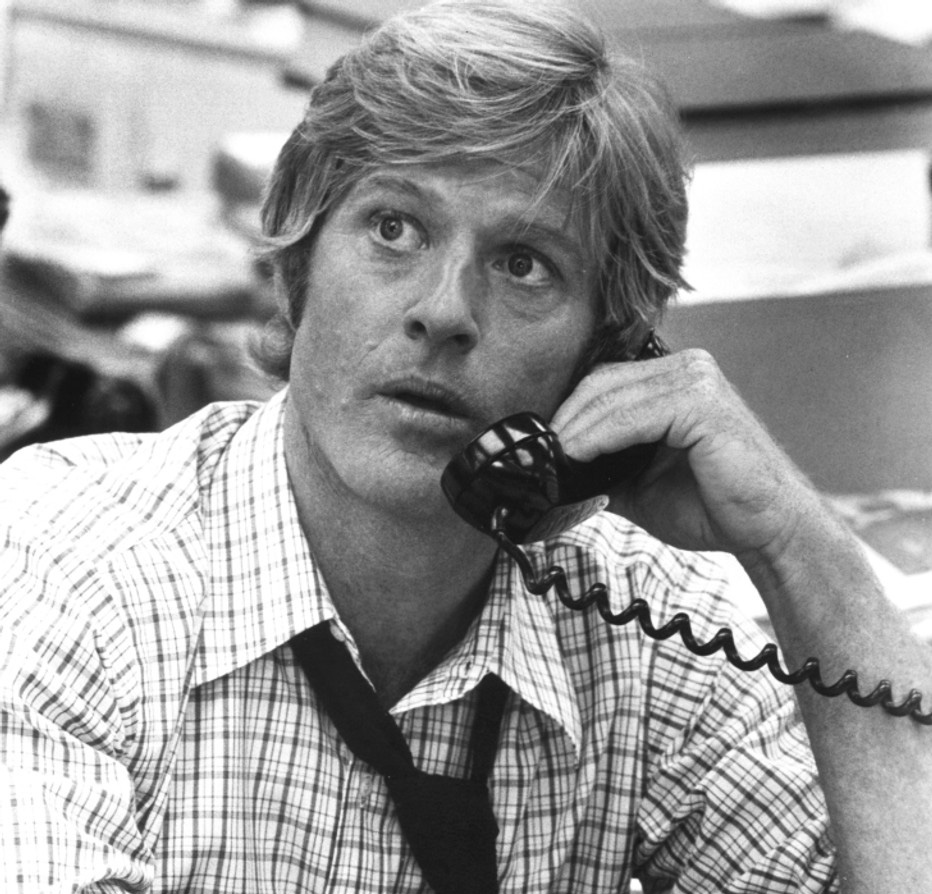
Having John Candy as a romantic lead without a lot of conspicuous comment, even of the Marty kind, though there are similarities to that, is one of the best, more subtle strokes. And it gets in some good blows of that sort of Marty frankness updated for the times. But it's just that writer, director Chris Columbus is so not subtle about so much else, especially the jumps to cushy romantic optimism, like the scene where Maureen O'Hara flips from warship to heel-kicker at Anthony Quinn's mashing.
An attempt to create a legendary bad movie dream team, even a showdown between Samurai Cop and Tommy Wiseau, also tries to get -- conceptual? -- on the B-movie level and, well, it is certainly bad, but in a way that lacks all the charm of the original or even other movies it refers to. It's a head fuzz, if not ache, of disconnected gyration, if it doesn't make you sick with extra agitated handheld and arc shots. The cast also includes other stamps of quality such as Joe Estevez, Bai Ling and Mel Novak, and apparent porn stars and strippers.
Partly in anticipation of the John Candy documentary, there's this item in his John Hughes run right between Planes, Trains and Automobiles, the best movie for both Johns, and Uncle Buck. Though written by Hughes, this is directed by Howard Deutsch, who directed other Hughes films, and it's more straight comedy hijinks in the National Lampoon vein that Hughes also wrote. It has its moments, and it's notable that Candy isn't the complete fool version of a funny man. The twist on that is the way Dan Aykroyd's hustler broker thinks he's the straight man. It's the kind of character Aykroyd was good at on SNL, but as the index of the whole movie, it's not consistent. Perhaps, to be generous, the unevenness tempers the characters, but it feels like playing around with them capriciously, sliding in different directions for gags or other aims (like the romance of the teens) which don't all work smoothly together. This was Annette Bening's feature movie debut.
Sicario: Day of the Soldado (2018)
Director Dennis Villeneuve shows the sort of composure that goes together with the acting, what he gets together with his actors, and that can sometimes seem like a matter of not doing rather than conspicuous actions. The contrast of Josh Brolin and Benecio del Toro bears this out particularly, how Brolin's peppiness and insouciance for the grim circumstances, but also del Toro's shadowy manner just like his character's background, are carried in the general tone. For that matter, it may be the best role for Del Toro. And while Enemy is Villeneuve's best movie, this may show his ability even more. Taylor Sheridan's script may be notching up things a bit as hype, but with the details and the way Villeneuve conducts it, it's involved, compelling.
The sequel provides a contrast and particularly about how subtle that sort of composure can be. Sheridan's script goes up a notch or two, so that it's teasing more the line between concern for real life issues and embellishment. Director Stefano Sollima follows suit with a steady hand, compared to lots of conventional thrillers and even drama, but it doesn't achieve the mood and tone Villeneuve did.
The Siege (1998)
This is an example of the more conventional thriller that has lots of similarities in the plot -- foreign nationals, clash of enforcement agencies, issue of CIA operating inside the U.S., a female agent and some operatives of suspect membership. Director Edward Zwick manages the material, which may be unnecessarily complicated by the script, but it's certainly more melodramatic in general, although it also involves a foreboding of the use of the army on American soil. Besides the interesting combination with the principles -- Denzel Washington, Annette Bening, Tony Shaloub and Bruce Willis -- there are also future members of The Wire cast, Lance Reddick, Wood Harris and David Costabile.
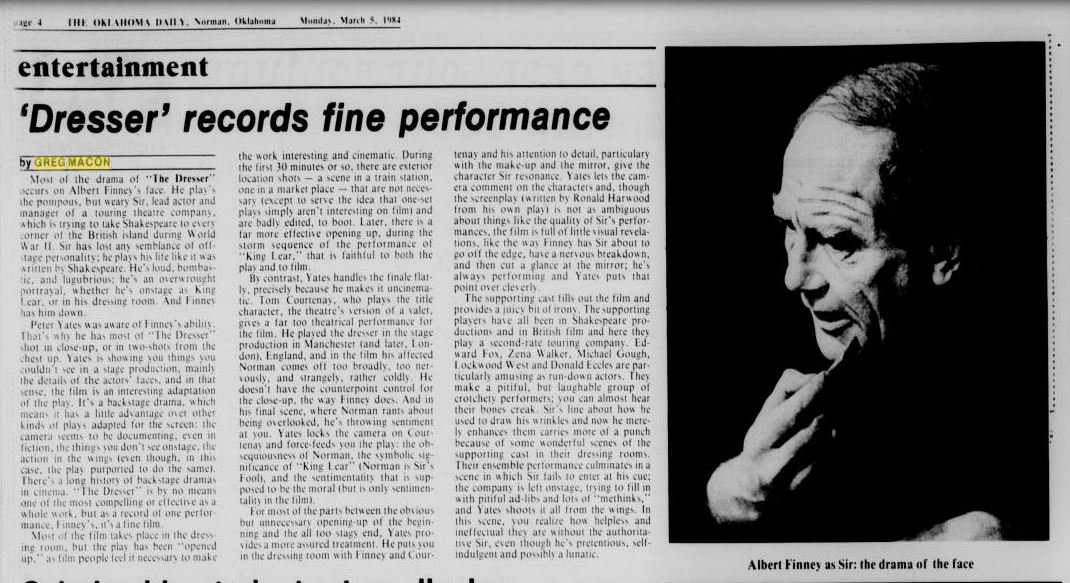
Albert Finney in stage makeup for King Lear makes a great turn for the movies on backstage drama. We see the heavier makeup up close, but Finney acting through that, though his actor character also has his own bombastic extravagance, which goes with other parallels of Lear, with his own fool Tom Courtenay as the dresser. Peter Yates directed, and shows more of the range that auteur theorists liked to remark about studio directors, as I've commented before, John and Mary: see also The Friends of Eddie Coyle, Breaking Away, The Hot Rock, Bullitt, even Krull. I reviewed this for The Oklahoma Daily when it first came out: see here.
The first big spectacle movie of the 1950s to win the best picture Oscar, this certainly makes the figure of "tentpole" more explicit, though that term wasn't used till after the blockbusters of the 70s and 80s, and Cecil B. DeMille, the maker of big showboats from the silent era, directed, and also narrated. That latter is part of the way this movie is an even stranger testament to the era. Heavy prose overworks the metaphor of the circus as a great machine over montage of large-scale setup, loading and travel. It resembles the 50s industrial or educational films that have also been the butt of many jokes of successive generations. That alternates with soap opera-like scenes in mostly dialogue and, of course, circus acts, so that the former seem like they've been inserted in a promotional film. SEE: Charlton Heston eat a doughnut!
The kind of graphic sense that shows how both comic books and movies can tell stories better with the imagery, in other words, not being simply subordinated as illustration. Computer graphics were another tool for the artists who used traditional techniques from not only hand-drawn art, but older movies (it was the largest team of animators ever assembled for a Sony movie at that time), and as CG and AI grow as surrogate or dependency, this is a case of using computer technology actively and deftly.
Samuel Fuller didn't really return to his early 50s type movies, because this project got started back then. The Steel Helmet and Merrill's Marauders may have been warmup, but it was the latter that also got this project cancelled when Fuller argued with Jack Warner over cuts. It's based on his own experiences -- the Robert Carradine character is a stand-in -- and by the time it made it to production and release, it was as interesting for other contrasts and anachronisms as for Fuller's. It was the thick of the Vietnam movie era, Lee Marvin led a cast of young stars like Carradine and Mark Hamill, and the more independent way Fuller had worked earlier had become the norm. Fuller's blend of pulp and poetry had influenced Godard and Scorsese, and here it looked like a minor key, compared to Apocalypse Now, not to mention all the other lavish productions the "new" Hollywood had become with blockbusters, but that was also refreshing. The makeshift feel which can seem more like playacting, or even pushy as with the birth in a tank or the asylum scene with Stephane Audran, also gives into the great quiet step of Marvin with the boy from the concentration camp. A 2004 restored version, called The Big Red One: The Reconstruction, contains material that was cut from the 1980 theatrical release.
Similar to Jesse James, this is a crisp confection of lore faithful more to the time it's portraying, directed by Raoul Walsh (The Thief of Baghdad, High Sierra, White Heat, They Drive by Night). Compare with Little Big Man, both taking liberties from their respective points of view, but also with Custer of the West.
Diminishing returns. The pop of the first one had to do with not rolling out quite like a typical action movie. Now the cat's out of the bag, and despite game effort from Sharon Stone among others, without the low-key approach as contrast, it's just a lower-level action thriller melodrama. You know where it's going because of the highway the previous vehicle got onto.
There's always jokes to be had from the seriousness of movie or series tropes -- SNL's longevity is one kind of testament to this -- but a remake of, or even just another in the line of the Naked Gun, seems to be missed opportunity. When part of the joke is to have it delivered by actors spoofing their own typically heavy, if not heavy-handed, roles, great comic ability isn't necessary. It's not so much that Liam Neeson isn't as funny as Leslie Nielsen -- there's even set-up for this with Neeson talking to a picture of Nielsen as his character's father about being the same but original -- as that Neeson has a whole other line of work for this treatment. There are some good gags, here, but the bulk of it lacks fizz.
The sharks that ate Paris. The curiosity here comes from the bright, competent cast and crew executing so seriously the premise that would seem to belong to a much sillier or cheaper shark movie. It's like one of those Samuel Becket passages where you get drawn into convoluted calculations some character is making and then you remember, it's about sucking pebbles!

Katharine Hepburn's theater nerd character is such a great twist on the stage drama of the day that the inevitable collapse into stage melodrama is disappointing. Her Eva Lovelace, the character's own pseudonym, is brainy and out of touch (she's a precursor to Candice Bergen's T.R. Baskin), a bit of a philosopher and celebrity worshiper, and has bought the silly ideal too much to even think her talent might point elsewhere. It would've been great to see this played out where it doesn't become just the same dream -- well, gotta keep those viewers hitched to a star, and she is Katharine Hepburn, after all, and won her first Oscar for this -- but it does have another punch of its own, another kind of price to pay.
The idea of merging, literally or spiritually, should give second thoughts, even if you don't go straight to a grotesque exaggeration. There is one scene in this that gives us that figure, and packs all the illustrative power necessary, like maybe a painting by Hieronymous Bosch or Francis Bacon. Writer and director Michael Shanks is more interested in tracking out the ordeal, in echoing The Thing, and, although religion would also have its place in consideration of merging or bonding, in a sinister cult line that takes the allegorical edge off it as the matter of a couple or just the conjugal ideal.
The Toxic Avenger (1984)
In updating Troma's best known product, this movie looks and acts more like the mainstream 80s movies the original was not. The former was brazenly scruffy and anti-virtuoso, more trash than punk, a sloppy barrage with constant filler music like porn. The remake, which went through a long gestation of different backers and makers, benefits from the sort of cultivation of time and generations for even iconoclasm. Macon Blair ended up writing and directing this -- you may know him as an actor in things like Blue Ruin -- and growing up on Troma and writing for Dark Horse Comics as well as Marvel, he's refined the act of smashing things to the punch of wit, similar to Troma alum James Gunn. (And there's lots to be said for a playground of breaking decorum: cf. Roger Corman and all that came through him, Francis Coppola and Martina Scorsese just the most illustrious.) It's toned down from sheer splatter, dressed up a little more with costume and production design, though still affectionately homey, and though it starts out a bit too posey and self-conscious, works up to a tempo of rolling bursts of gleeful absurdity. The whole cast seems to savor the experience, including Peter Dinklage and Kevin Bacon, and Elijah Wood looking like the love child of Oswald Cobblepot and Rocky Horror's Riff Raff.
In the taxonomy of shark movies, this Australian variety is the more modest type, though ambitious in the more traditional story and movie way, similar to Open Water and The Shallows. It concentrates on the ordeal, not on blockbuster or even low-budget effect, CG or silliness, and it's based on a true story.
It's not the smoothest ride, but this documentary of Astor Piazzolla, the bandoneon player who combined other influences to create a new kind of tango, has lots of material, in large part due to the offering from archives by the artist's son. This shows all the lines of Piazzolla's formation, including New York and Europe as well as Argentina, an artist of the world much like Jorge Luis Borges whose path he also crossed as referred to here, too.
Sideways (2004)
After the success of Election, Alexander Payne's next two works were closer to literal journey stories. Though Mathew Broderick's character certainly has a more figurative journey of transformation in the previous, Jack Nicholson's Schmidt goes on the literal road for a bit, and then Sideways is all about the road trip of Paul Giamatti and Thomas Haden Church's characters. Similar to the way Payne mixes comedy and drama so that it's quite neither, certainly not the conventional, conspicuous forms, he shifts arc and episode so that they're discursive in both senses: rambling and digressive, but also a process. The movies seem to refine this process chronologically, with Sideways perking up and sharpening the whole act, and then The Descendants and Nebraska refining it in different ways. But while About Schmidt can seem more hesitant and groping, there is also a point to it that's exceptional, and a payoff that seems even better than the setup. It's emphatically divergent in that its transformative journey happens to someone who is not transformed. It's a climactic anti-climax, but then comes the last scene where he looks at the drawing made for him by the African boy, after the comic pathetic of his correspondence with him. That's a pow, and it might even be a better setup for it that the rest of the movie seem mired or middling. Like the paper moon in Le Million, or things that make apparent the barest means of figure or pretending (see comments for Grand Theft Hamlet), it's the minimal representation that shows the grand, all the more the effectiveness of it.
There's plenty here of interest, certainly in its day if less so now: written by Ted Leighton, which is the pseudonym of the team Richard Levinson and William Link, creators of Columbo, among other things, and Peter Hyams; directed by Buzz Kulik of much TV as well as movies (e.g., Brian's Song); with star Steve McQueen playing a real life modern bounty hunter, and a supporting cast including Kathryn Harrold, Eli Wallach, LaVar Burton and Ben Johnson; and a famous set piece stunt with a car going off one Chicago's Marina City towers. Of interest looking back is the way this goes against the grain, an apparent action movie whose hero has no particularly great skill, certainly not driving (cf. McQueen's amateur racing and racing movies), deals first in non-violent ways, and has a lifestyle that's more like a hippie commune, with a cosmopolitan attitude to go with it. Despite a couple of stunts to make it seem grander than TV, it really ambles around in pace more like a series, and juggles all its plot points in a way that makes them detract from each other.
It's certainly a quirky indie rom-com, but the undercurrent with the low-key, self-deprecating humor that Taika Waititi and Jemaine Clement and company have wrought at large since -- this is Waititi's feature debut -- make it more interesting. Though it seems to play as types, nerds and misfits, there's a way that it works as a broader caricature of relationships, a parody exaggeration of men and women more generally, or even the complementary kinds of foolishness of acting too cool or being a pushover. And there are nice moments from Waititi and co-writer Loren Horsley, who is also the star, such as the echo of "Lily" on all the slips used in a drawing to fire her with the people later all cheering her name.

Sneak attack. Even in Alexander Payne's line, this is something of a curveball, unassuming from more than one direction. It looks like it would be a more typical family comedy drama set piece, and behaves that way somewhat, but the way Payne handles the seriousness, or directness, and lightness defies either typical comedy or drama and ends up having a far better effect. Two things come out of this with surprising coverage: dealing with death, and a larger civility and forgiveness that couches even jealousy, anger, grudge. It's even in the way George Clooney carries himself physically, a slight slouch that's also a bit nerdy, as his character says: "Don't be fooled by appearances. In Hawaii some of the most powerful people look like bums and stuntmen." And there's a great performance from Shailene Woodley.
Jean-Claude Van Damme proved not so much that he wasn't just a karate guy who could rise above simplistic low-budget karate movies, as Lionheart director Sam Lettich said, as that he could raise simplistic karate guy movies to blockbuster, or at least big-budget status. This is Van Damme's highest grossing lead-role movie, and in case you took no notice of such things, was produced in part by Sam Raimi, directed by Peter Hyams (see T.R. Baskin for additional bemusement), and involves the likes of Ron Silver, Bruce McGill, Gloria Reuben, Scott Lawrence and Kenneth Welsh (hot off his Twin Peaks fame, if action movie audiences of the day noticed that). And here it is now the subject of a RiffTrax live treatment. Well, if efforts like Point Break are worthy, it's certainly no stretch for this movie, which really stretched B-movie quality to big budget. You can see how things didn't quite fill out in the sort of warehouse spaciness to everything, the future cars that resemble the way dogs are sometimes given costumes to be monsters, and from the very conception that's more like a bucket of assorted plot points. The real time conundrum here is whether 2004 looks worse than 1994. Van Damme's "later" hairdo looks like cake icing, but he sounds like he's recorded at a lower level than everyone else. Some of the editing looks accidental.
The stammering, lurching inarticulateness Joaquin Phoenix and Deirdre O'Connell play for their characters is the best thing about this, but the whole conception of it has its own version of that at another level. There's draw, interest and appeal, from the attention to that detail with the characters, and the crisp look to the laid-back bystander mien by writer and director Ari Aster. But there's a pushy contrivance to the lines of action, and even larger meandering and vagueness. The parable gait is too heavy for its social satire shoes.
It doesn't have the candid charm of My Man Godfrey despite a spirited attempt with Edward Arnold, so its play at poor folk slumming with the rich is more put-on, but there are some interesting signs of the times, however enhanced, including Joan Crawford using the great dolphin spout of the Horn & Hardart Automat for coffee and cream (see The Automat).
Zach Cregger builds on Barbarian. He doesn't go for the full Twilight Zone kind of allegory (cf. Jordan Peele), but he makes up for that with the inventiveness of the storytelling, finding other routes, approaches, contexts that are not typical genre horror, and which even in their creepy detail give an exuberance. On the one hand, here, there is at least one outright signal of the allegorical dimension, which makes the whole thing resonate with the title, but on the other, there's an internal resolution to the story that doesn't have all that play. The climax is not as drawn out as that of Barbarian but also not quite as surreal. Unless there's another kind of significance, a pattern -- was Zach terrorized by old women as a child, an aunt? It's such fun, and there's plenty of room for the ripples to play to make it more so. His overlapping paths cleverly involve the viewer by inferring linked material and not unnecessarily repeating. The surprise in a great cast is Austin Abrams who makes his chapter as much my favorite as it lets him shine.
There haven't been too many interesting things done with our computer experience, testaments to it more in form than just literal reference, and this manages it in such an offhand way it demonstrates that great complexity isn't necessary -- well, at some point along the line. As also an account of the quarantine experience it shows the way the two out-of-work actors happened on the idea, so it's also a record of its own development, and all to go along with the dovetail of themes and figures of Hamlet and Grand Theft Auto. The most complex means of evocation -- Shakespeare's language or all the technical prowess that brings about the game -- still depend on the barest pretense, simply pretending, that one thing can stand for another, stand on stage, or anything else can stand for a stage. In 2003 there was an art installation that involved live servers for the game Quake on line in which the performers of the piece typed out, in the game's chat, dialogue from the series Friends (see here). This was a forcible clash of worlds, the incongruity cutting both ways. Metaphor is making equal things that are not, but from the collision comes different light, shade, meaning. The performers here are unflaggingly affirming of others, but no less dull to irony, dark humor and existential matters. The question will likely come up while watching whether the full in-game performance of Hamlet was recorded. As Time reported,
The play [performed July 22, 2022] lasted just over two hours and 50 minutes (including time for the countless cast members who got killed by other players throughout) and garnered nearly five thousand viewers in the first three weeks on YouTube. While the video was previously available on YouTube on Crane's channel Rustic Mascara, the full play, along with various clips of the performance, have since been removed.(See here.) While it would be great to see, the play's the thing, and in the spirit of the theater, it had its live moment, virtually though it was, and is no more, while this movie has the beauty of memorial, document, making of and things like finding the other players, rehearsals and the after party at an online multiplayer GTA night club.
An interesting idea about a kind of time warp phenomenon set in the middle of some kitchen sink realism about a bayou family. The constant simmering, stewing and stirring suggests it adds up to more of a connection.
It's hard to ignore the idea of Black Widow vs. Jurassic World nearly the entire time because of Scarlett Johansson's character and the setup, but despite that, it actually manages to tone down not just the superhero level, but some of the more annoying character wiggling of the entire Jurassic franchise. It nearly makes up for that gain, though, with a tiny dinosaur pet sidekick ploy, and in a different direction, with a mutation that's like Frankenstein Alien Rex. But it's still the same ride though you're not even getting dinosaurs anymore.
In the movie there's talk of moving the whole world from the villain or bringing the villain to the world. It seems Marvel, in whatever version or reboot or attempt at the Fantastic Four in movies this is by now, has finally decided the way to make them fit is to bring the world to them. They've designed a whole world -- alternate universe, actually, Earth 828 in the multiverse -- more suitable for the Fantastic Four, from their costumes to the more old-fashioned, squeakier, younger kid quality to things. Well, superhero things, anyway. Even the look of the Marvel logo at the beginning heralds this, and the whole yesterday's tomorrows approach, Technicolor Brooklyn mixed with the Jetsons, also calls to mind an earlier era of comics as well as younger age of interest in them and function of the fantasy, before the addition or understanding of the more grown-up complexity that Marvel was particularly responsible for in the 60s, and now, after the X-Men in movies, for making cliche. Superheroes as misfits, outlaws and self-satire has now become routine if not cliche, certainly a saturated market. So, somewhat like Captain America: The First Avenger, this actually makes an interesting turn, at least a contrast, with, similarly, mixed results. There are some unintentionally humorous moments because of this reattempted earnestness, for example when The Thing / Ben Grimm, played (mostly voiced) by Ebon Moss-Bachrach is exhorting Pedro Pascal as Mr. Fantastic / Reed Richards the way Richie would Carmy in The Bear, or when Vanessa Kirby as Sue Storm / Invisible Woman interacts with a crowd that is made to respond as intimately. Even with that, the lead team cast is solid, and more successful than their predecessors, part of the better outfit, especially Kirby.
You might get the idea watching a rom-com that if you drained all the syrup or knocked the spunky smugness out of it, it could be tolerable. Here's something that suggests maybe that wouldn't be better. This is played so straight, and has moments when it seems to be getting into more involved discussion, but ends up having the same kind of arc and structure of a rom-com, and especially its upshot, that it rather makes the serious moments seem more frivolous, if not just strange. This even casts in the other direction on writer, director Celine Song's Past Lives, so that attention to discussion not typically movie script, placid and controlled delivery with the actors, staid nearly long two shots, seem more like its own cutesiness.
In the line of American Splendor and Robert Crumb, this is a fictional story of someone who aspires to the heights, or rather depths, of underground comics. Conscientiously more ratty and rooting around, it's a series of encounters that the lead character is as outrageous for seeking out and prolonging as any of the others he meet are eccentric. The best moment of the whole thing is the off-the-cuff drawing he makes of the heat-seeking basement dwellers, and if that has the effect of showing the razor-edge flash of art, it may be all the more to the point of the shiftless skittering all around it. Writer, director Owen Kline's slumming, haphazard course, where even moments of awkwardness in the effort, as with improv, can serve for the awkwardness sought, has the sort of rapt following after its subjects that keeps it more interesting than just posturing, if it's not as concerted as American Splendor.
The performances of Toby Jones and Harry Lawtey carry this, that, despite its inherent interest -- the unusual background story of actor Richard Burton -- takes on a more fairy tale air. In the early going, they hold the interest so that by the time it settles in and becomes more apparent, then even more conspicuous with their involvement in the lush precious tone, you realize that even the grit and banality of it have been made awfully fuzzy.
Rousing anecdotal history of writer, director Richard Shepard using mostly clips from other movies, a testament to his own concentration on that as he grew up, i.e. his obsession, and featuring the movies of his formative years, the 70s and 80s, montaged with home movies, photos and makeshift storyboard animation. It's also the tale of his father, who was quite a character in his own right. The material has its own appeal, but the presentation also takes you into a rolling pace, though it tends to flag past the middle with looping to the same points. Shepard makes the case that his father influenced the movies he made, especially three of them he wrote as well as directed, and after this statement with support from so many illustrious character witnesses and interested parties -- all those other movies -- one can only wonder why he didn't make the movie of particularly that character of his father. Cf:
The Matador (2005) is Shepard's best movie, and it may be Pierce Brosnan's best performance. The more modest conception also makes it tighter, sleeker, a cleaner stroke. The buddy adventure comedy form gives it an unassuming base, and while there's no great original turn, it's more the context and turns it makes within that frame, something that seems to be Greg Kinnear's specialty, and is here extended to Brosnan. It doesn't go too much for the thriller action, but for the characters, and doesn't drag that into exposition, but keeps up the dance of their performances.
By contrast, Dom Hemingway (2013) keeps bounding from one segment to another and facets of the character as if into different movies or registers, and the tour de force performance intended for Jude Law is all over the place. Psychopathically sexual, a loose cannon knucklehead goon, all that just the act of a bullshitter, wily expert safecracker, or just the dumb luck product of circumstance, and then penitent father, it's so many jags themselves derivative of geezer comedy drama.
The Hunting Party (2007) is perhaps the most ambitious Shepard project, but thus the most disappointing. While the Richard Gere character has some of the qualities Shepard describes of his father, not playing by the rules, a wily, mystifying resourcefulness, an outsider or misfit but socially shrewd, it's about events following the Bosnian War when some journalists went looking for a Serbian war criminal. It's loosely based on the article "What I Did on My Summer Vacation" in Esquire October 2000, but while Shepard includes so many of the actual people in the movie and has a sequence at the end pointing them all out, he departs from the events as told in the article in a very tailored movie script way that is not as interesting.
At the point we are now, where paramilitaries who opposed the police have quasi-official status, and the whole confusion of it is being exploited, I'm not sure even what this aspires to as a dramatic study is relevant, though not entirely its own doing. There are good performances, especially by Nick Offerman and Martha Plimpton, but there is nothing particularly penetrating about this, or even elaborated about the notions of sovereignty and their extrapolation by the Offerman character. The way it resolves to the frame of Dennis Quaid's family gives the impression of regular folk who don't want to examine the presumptions of any of us.
A nice twist to shark movies is one that backgrounds the sharks so there's very little to actually do with them, and thus very little of the cliches, including the latter day ones with CG. The movie is so aware of this it cranks up the payoff moment so that it's as much that comment. This is all because the premise has sharks as only the means of the more dangerous animal, and thus it's really more a slasher movie. It also gets a nice moment of poetic flourish to make that point about which is the more dangerous (the tagline is "you're safer in the water"). It's a competent production that, despite how gimmicky the combo sounds, manages to avoid a lot of the cliches of either, but the best of it is the cast, especially its leads Hassie Harrison and Jai Courtney, and that director Sean Byrne does well with them.
The codification of popular melodrama was well in place by the time of this Oscar best picture nominated project from MGM in Britain, directed by King Vidor. The source was a novelization by A.J. Cronin of his experiences in the medical profession, and it and this movie are interesting for coverage of lung disease in mine workers, the problem of careerism over scientific and medical ethics, and the development of collective pay medical societies which were the model for the British National Health Service. All this is rolled along with the dash of a billiards game of rising and falling action of self-sacrificing nobility and self-realization, in the screenplay of Ian Dalrymple, Frank Wead and Elizabeth Hill. With actors such as Ronald Donat (of The 39 Steps fame and who would win the Oscar the next year for Goodbye, Mr. Chips), Rosalind Russell, Ralph Richardson, Rex Harrison, the question of whether the movies were more melodramatic or simplified, aiming lower or dummied down has rather a different orientation, since they not only used so much theater personnel, but also aimed at the theater to some extent as a model, which some would say was the restriction (see Rene Clair). Even Cronin fictionalized his account. The relation between Hollywood and Britain, stage or movie-making, is tangled, too, not dichotomies.
Interesting for all its parts, not just Jane Russell's, which don't add up to a very good whole, probably not least because of Howard Hughes tampering to the point of essentially remaking it. While Robert Mitchum, Raymond Burr, Jim Backus and even Tim Holt are part of the medley, Vincent Price rivaled Russell for Hughes's special treatment. Hughes wanted to expand the part for Price playing a ham actor, and when John Farrow, who directed the original release, refused, Hughes brought in Richard Fleischer. The result is that despite Price's game performance, spouting Shakespearesque quips, there's no coherent take on the character, sorta comic, sorta parody, sorta noble, sorta rakish, sorta like the whole movie. With everything drifting into action sequences that diffuse rather then tighten the story, let alone suspense, not even the title ends up making much sense.
Watching an episode of The Bear not long after I saw this, I was thinking about the way that show elaborates without seeming only like plot, which is also analogous to one of the points it's making within the story (people obsessing so much over making flowers who don't know how to smell them). There was something about this movie I couldn't quite place, and I think that's it. It's trying to express things as other kinds of elaboration, too, but the structure of it has other effects. The way it cuts up what it's covering, the amount of time overall and the portions of it, on the one hand, and on the other, the way that some scenes are pressed for an expression so much they become confusing, counter to mundane or candid, creates an overall problem: the tension about what this relationship is becomes as much the tension about what the movie itself is making significant. It's a dramatic ambiguity that creates all the ponderousness over the relationship. Celine Song, writing and directing, does a good job giving us discussions we don't get much of in movies, like that in the bed between husband and wife over their feelings about another relationship, the overreaching people do in their mind long before it's even any kind of movie plot, but in the frame of a conversation in the proportion of a bedroom, not even the action of a drawing room drama. But it's not cut with anything mundane as far as letting it go, small talk, whether diverting for any psychological reason or just the general one of diversion, or just paying attention to other things. It's mounted up, the weight increased, dragged out to an overriding solemnity.
Once you get used to it and settle more into the story, the plainness of its attempt at plainness doesn't stick out as much, but it's kind of like Joe Mantegna, next to Ornella Muti no less, meting out his Italian accent with his pacing that sounds as careful as dramatic. I couldn't help thinking of Fat Tony, of The Simpsons, as the spoof abstraction of so many of his other characters, and the contrast this produces. But if you make it through, this work based on a John Fante novel, presented by Francis Ford Coppola (produced by his Zoetrope), and with a score by Angelo Badalamenti, manages to be affecting.
I Know What You Did Last Summer (1997)
A woman's touch has some interesting effects here and there, but doesn't amount to much applied to this slasher formula and sequel re-do/make/boot to boot, with the now de rigueur reciting of the source -- the whole point here is that "original" is long gone moot -- directly and indirectly and any way besides. Jennifer Kaytin Robinson, who co-wrote Thor: Love and Thunder and contributed to its more significant flourishes, directed this as well as co-wrote it. What she does carry from the predecessor is the more basic approach, conceptually and cinematically. Apart from not being lots of big CG spectacle as horror films have become progressively since the 90s, there's also more concentration on context, setup, composition, creating suspense and effect from that and not so much gore and elaborate kill contraptions. What the revamp remains stuck to is the pandering type conception, a kind of meta all too part and parcel of the whole slasher line: manipulation of not so much audience empathy or identification as draw or hook (har har), whether ironic or not. Even this movie's title works like that. The main premise point, where the victims are first murderers, has much more potential than the superficial mechanics of that -- so it's rather like opting for jump scare over broader atmosphere or effect -- and in trying to make even that more ambiguous for the characters in this new version, I could only think of Jordan Peele, how much more he gets from allegorical and surreal ripples. I was imagining my own re- or per- version where white privileged sleaze whole-heartedly torture and kill someone, for being whatever different or for no reason at all, and then are tracked down by someone or thing that seems by turns a super-powerful killer, a super AI robot, a malignant supernatural force or just a symbol, but instead of revenge it turns out to be just ridding the world of creatures worth less than they think their own victim.
Pam Grier's last movie with American International also features quite a supporting cast: Carl Weathers, Eartha Kitt, Scatman Crothers, Jim Backus, Godfrey Cambridge, and Yaphet Kotto who fairly steals the show. As blaxpoitation it has its caper plot to generate action and sensation, but there's also grandstanding provided by, for example, a fashion show presided over by Kitt in blustery form. The toning down on lurid doesn't tone up much beyond TV level, like a pilot for a series.
Good-natured dismemberment and sublimation -- it gets giddy with chainsaw -- but despite the premise rigged to blow, as much The Pink Panther Strikes Again as Bullet Train, it doesn't roll.
Glenn Close helped write and produce this based on an Off-Broadway play for which she won an Obie Award in 1982. (The play was based on a 1927 novella by George Moore.) The cast is excellent, especially Close and Janet McTeer but the work, directed by Rodrigo Garcia, stutters between comedy of manners and something more tragic, sometimes in the same scene, but thus across the whole. It's worth a return -- for any of its times, movie, play or novel, but thus for any time -- for how gender is social especially when it's constraint or oppression, and how the move to suppress even that understanding only has other effects (analogous to how the first collection of statistics from public records in Paris turned up the problem of suicide among unwed mothers).
It's fun, if not great, but that's not bad, and that's good. It has its attempt at golden moments, so it doesn't entirely escape the origin story, great stroke compulsion (an intro for the Amazon Prime special premier has James Gunn next to cast members saying he's been wanting to make this Superman for years) but lots of James Gunn's low-key impulses help counter the grandiosity and spectacular that have now become not just commonplace but tiresome, even right here in the same movie. So on top of a whole thematic emphasis on Superman's being human along with us, even if he wasn't born here (he was raised, one of the many not even really crypto comments about current affairs), there's also the way he's not even the best thing in the movie. The Guy Gardner Green Lantern and especially Mr. Terrific have more punch for being surprising characters to turn up, but also comically. And having a battle going on in the background of a dialogue scene between Superman and Lois Lane is a prime example of how Gunn shifts things for other effects.
The New Land (1972)
In case you need a reminder of what immigration means for not just the history, but the raison d'etre of the United States, there are these Swedish films that are something of pioneers in their own right. Based on a novel series (of four) by Vilhelm Moburg, these were written, directed and edited by Jan Troell, at the same time rather than as separate productions, though released separately. Each movie is over three hours, The Emigrants at 192 minutes (cut to 150 for its original American release), The New Land 202 minutes. There was not a video version until 2016 when The Criterion Collection released them on DVD and Blu-ray.
As an attempt at cinematic realism about an era before there was cinema as such -- in other words, a period piece trying to be more documentary-like than costume drama -- this material was novel in its fastidiousness about the perspective of its subjects. The script attempts an account of the way these peasants in Sweden saw things from there own context, their religious beliefs and social station, their own way of characterizing things that could also be uneducated or due to more general ignorance of the time, superstition or broadly held ideas. They can sound stiff or dainty, but also frank or crude. The hardship of their lives is portrayed, not just the natural but also as a result of religious and political oppression. While it may seem muckraking for all that, in particular the long segment of their transatlantic voyage, Troell's cinematic depiction includes the bucolic environment though with a quieter juxtaposition of its beauty or pleasures, not epic grandeur. It's mapped out according to this, a kind of social history approach, and not the typical sort of dramatic rising and falling or empathy built around a protagonist. Troell has a bearing that's close, even lush at times, without being ingratiating, but also distant, almost clinical, without being detached or dry. If he doesn't have the lyrical sweep of Pather Panchali -- the comparison with Satyajit Ray is also because of all the roles Troell served in the film-making (Ray also did his own music) -- there's a similar combination of the beauty and squalor of the environment, but with a more dispassionate regard, especially with children, meaning of course not coldness or lack of care, but more circumspect. As the ocean voyage particularly bears out, Troell's plan minimizes establishment shots in favor of closer shots among the group, emphasizing that perspective, even with its more sober bearing.
The New Land has more variety of style and technique, Troell particularly showing a deft elliptical approach to a concurrent story line in flashback, flourishes of character expression -- Max von Sydow and Liv Ullman play the head of the main family, and especially if you've seen them in Ingmar Bergman movies or so much more, it's like watching them start afresh and go through a whole acting career through the development of these characters -- and even some quite aggressive modern choices of music and rapid-fire editing. The first film follows a shorter period in more detail, while the second spreads out to cover much more time, the rest of the characters' lives in the new land. While it shows what they become with the country, it also makes the point more diffuse, if not vague or even lost, and the first movie a more compact figure by comparison.
"There's a new Marvel out that's supposed to be nuts. We should go see that." Andrew DeYoung, as writer and director, strikes a good balance, neither too zany to be serious nor too serious to lose the surreal edge to the comic, and gets that from his cast as well, led by Tim Robinson and Paul Rudd. The characters flicker between absurdity and banality, vanity and vulnerability, status and desperation, so they keep you on the edge of your empathy -- and that also teetering between them. It's like cathartic comedy played a bit straighter with the cadence of psychological thriller, without signaling either too much.
Philip Kaufman has a good, certainly big conception, but is not as good with detail. There's a tilt to this, which keeps it from being straight bravado, ceremony, glorification, in the glossy popular American movie way, and certainly makes it more interesting, but a lot of it seems off kilter or just off, poor comic timing or like that when not anything particularly comic. Poor dramatic timing, in some cases. As with The Great Northfield Minnesota Raid, he's trying to put all that showmanship in the frame, too. There's a brief moment at an airbase that made me think of the airport scene in Nashville, and I think Kaufman was trying to do something similar to that movie, an epic sweep of satire that catches up the grandeur as part of the vanity being debunked or at least observed, not credulous but still involved, but it doesn't sing like that, doesn't have that immersive characterization even as comedy or satire, save for glimpses here and there, especially with Sam Shepard.
Fable play. It's a well-made or supremely polished popular movie, but there's more to that too by being also not all that, not just that. The more elaborate artistic consideration Ridley Scott gave to the monster movie and film noir and sci-fi, with Alien and Blade Runner, he did here for the popular form of perhaps road or crime or buddy movie. And then, to boot, from its script by Callie Khouri (her first), it's a feminist twist on at least the bulk of the tradition, although fugitive couple movies with at least one female member have their own prominent line. It works better, has better value, thinking of it as less than more. Those previous two movies have reach or valence but it's their movement as plot that keeps them from declamation, artsy or messagy, almost the opposite of the problem of American movies generally (although Blade Runner showed both the more subtle openness for figure and the more heavy-handed approach). If this is anything in particular, even a road movie, it stumbles into it, and works different lines and as counterpoint to any particular, somewhat like McCabe and Mrs. Miller.
The fourth act -- the third act is actually the first chronologically -- brings this together as a wretches' ballet, but that's if you can make it till then, because the first three acts are the worst theater Quentin Tarantino is still trying to pass off as cinematic, with the whole premise given in exposition, laborious provocations, and an absurd extent of digression. All these things were clever exceptions and flourishes in the beginning, with Reservoir Dogs, and through the better construction and movie -- moving picture -- composition of Pulp Fiction and Jackie Brown. By the time we get to projectile vomiting blood, I'm just thinking it flat stinks, and that's about half way through.
Scary Movie 2 (2001)
An Airplane or Police Squad/Naked Gun type spoof of slasher movies has a primed audience with familiars or detractors, and that type of humor doesn't quite have to worry about hit or miss, since even thuds are part of the silliness. The Wayans brothers -- Keenen Ivory directed, Shawn and Marlon wrote -- cast a wider net of cultural reference which keeps it from tracking the one target too much. But the risk of being rote that way, and repeating the tedium of slashers, isn't avoided by the repetition of the type of humor and reference. There are hits all along the way and some larger arcs with payoff, but the unevenness when it's a just string of gags tends towards a din. The sequel (the ad tagline for the first was "no mercy, no shame, no sequel") gets into the celebrity bandwagon, but then a Clue, Rocky Horror, It vibe with Tim Curry, and some long stretches of Chris Elliot, who's about straining tolerance anyway.
Starts out stiff, making scenes -- each scene has its own sort of puffy report -- without blending them to a better whole, but then relaxes into more interesting composition. As ever, it's the plot arc that prevents more figurative or poetic study. It's interesting how this is especially so when Michael Caine shows up, his composure better than a sort of formal movie acting, and even Sigourney Weaver's character makes more sense after that. She's more feeling and expression and less exposition.
Close to right down the middle of the Marvel product, neither best nor worst, but just doesn't quite make that. It's certainly more interesting than Captain America: Brave New World, but that's sort of built in by things in the premise. The cast is interesting in its own right, although Julia Louis-Dreyfus has to work hardest against her villainous veep groove. Despite whatever setup for a cross with Avengers and Fantastic Four, the fugitive, vigilante, ragtag superheroes shtick doesn't have the same effect when there is no other. It's all things superhero now.
The problem with this is the subtitle. A collage of anecdotes and references and rehashing of info and background tidbits that are commonplace for the 50th anniversary for streaming service viewing doesn't really constitute much of an inside story, let alone a definitive one. For those who don't know that much about it, if there is anyone -- access to the movie is pretty much access to all that info too nowadays -- the chatty account by Spielberg of his difficulty -- hardly groundbreaking or penetrating here -- adds the most spice to what's pretty much a highlight review show for a birthday party.
The second volume of my film comments, after Film/Script, is now available. See also:

Two factors hamper the effectiveness, if not just the effect, of this: the compression of a novel into a feature-length plot, and the indulgence of using John Malkovich. J.M. Coetzee's book involves a lot of changes of context for characters -- needless to say most significantly for the main one -- that affect the point of view or the stance of the reader towards the character and the whole. The reader/viewer is taken through these shifts as a dramatic demonstration, a sort of performance of equivocation, turnabout, double standard rather than simply a statement of such as argument. Trying to cover so much plot gives it little chance to create a tone, especially in the early going, and Malkovich seems to be walking through this as a tourist to the stages of the character, even the attempt at the accent making it him more distant. Compare this to his thoroughly immersed scamp in Object of Beauty, what I think is his best role.
I wasn't quite as pshawish of it after all these years, but in its time, it was the beginning of the end of the exceptional Oscar period, the cusp of that and the "family values" bandwagon that took over even the movies, despite whatever unconventional or against-the-grain cred. What bothers me about it is that it just seems so tailored, especially compared to Alice Doesn't Live Here Anymore or Shoot the Moon. I'm still waiting for Godzilla vs. Kramer.
The decision to make this, the first novel in the series with the Hannibal Lector character, in the line of The Silence of the Lambs bears out the case for Manhunter. Despite little notice when it first came out, but already superior to Silence, which kicked off the Hannibal craze and was a popular and Oscar darling, Manhunter was a version of the book Red Dragon, and this movie, the second sequel with Anthony Hopkins, though an improvement over Hannibal, played up all the thriller notes for a fairly prosaic run through the material, with nothing like the atmosphere of Michael Mann's film.
An interesting premise about a series of murders in broad daylight on crowded subways is executed with composure, but falls into a more extravagant psychic duel that's as much soap opera as infatuation with soft-spoken sinister guru.
Though it's been called the greatest Russian horror film -- the genre didn't really exist in the Soviet era -- it's badly edited, even laughably in fight scenes, and often has a loitering quality rather than any intentional effect. There are some great effect scenes with a fisheye and shots in a tunnel at the beginning, then a couple of times sprinkled in, but this also doesn't amount to any overall composition or cadence, and the movie has that faded, earnest but listless quality.
One of those 80s movies going all out to hit right on teen boy fantasies in the most direct way they can without being porn, but making up for that with constant talk about sex. It's like an ADHD point of view where even obsession with sex can't keep attention, they put in as much stuff about birth control as if to also come off seeming like a public service ploy, but then the whole thing lurches into being about putting together a band. That's supposed to be more "real" than phony pop, but is a composite of gimmicks, like a bass player on a skateboard. Joan Collins is acting by herself in a room with voice-offs pretending to be in dialogue, and it turns out most of her stuff was shot before the rest of the movie and she and other actresses like Carrie Snodgrass sued the makers because they were misled about what the movie was. The Mrs. Robinson style "sex" scenes, really just some suggestive nude sets, were flagrantly shot with a stand-in for Collins.
While it may seem derivative of A Quiet Place by proximity, it's based on a novel written before that movie, and there are plenty of other predecessors about monstrous forces that make you see your fears or nightmares. But check out The Day of the Triffids for its own quirk of blindness added to invasion of alien plants. What this most echoes, even if incidentally, is Lost with its unseen bogey and apocalyptic soap opera.
Script writers Eric Pearson, Craig Kyle, Christopher L. Yost and director Taika Waititi, with delivery from their cast that included Jeff Goldblum, took the corniest, most heavy-handed of Marvel's A-list characters and made the peak of their sharper, wittier, livelier style, a la Guardians of the Galaxy or Deadpool, in the main hero line.
The most likely way to find this, and the best way, is as an episode of Mystery Science Theater 3000. To see that info and comments click here.
Netflix distribution based on true events of a serial killer in India, Nithari, Uttar Pradesh. While it's difficult to tell how much the dissonance of affectivity here is cross-cultural within the portrait, as opposed to because of the portrayal itself, this is notable, interesting, and finally compelling particularly for the Dashehra Diwali Mela, the festival around which many of the events occur (with it's effigies such as of the ten-headed Ravana); the way the perpetrator once interrogated has no compunction about divulging anything, what may seem more curious or even perverse, but even with cultural context differences attests to a more general factor of serial killer psychology; and an ending that carries the more affectless line into chilling matter of fact.
The various threads don't come together with the kind of allegorical punch of Us: an O Brother, Where Art Thou? style burlesque of early 20th century America, juke joint blues and rags, race relations, a coven of vampires. In part, it's the way it takes off on so many tracks, a plan that's more discursive and epic than figuratively drawn together.
Medley of cultural homage to Oakland of the 80s, with lots of references to movies of the era, in dialogue and otherwise, including a particular nod to Repo Man. Sweet and blunt in dressed-down style, it uses real events as a kind of setting to spin a pop celebration around, like a punk zine comic, and hits its action and violence points with just the right rhetorical pitch, more the formal sense of graphic than explicit, though it's not shy of that either, especially the first part about the Gilman Street club (and it hits the right note of anti-fascism, too). For a corresponding doc view of that last, see Turn It Around: The Story of East Bay Punk.
Special items
Diane Ladd
Diane Keaton
Robert Redford
Rare Birds
Terence Stamp
Movie Brains in print
Links
Index
Facebook group
Movie comments
Best by year
Movie calendar
Film/Script
Movie Brains (vol. 2)
Fixion home
Pages
2025
2024b
2024
2023b
2023
2022b
2022
2021
2020
2019
Rare Birds
Monster Movie Survey
Backlog
Enter the Lists
Anatomy of Bad
The (TV) Show Pantheon
About
Entries by Greg Macon for the Facebook group Movie Brains, related to film comments on this website, Fixion. Text for movie comments this page © 2025 Greg Macon. Banner image and quote from Earth vs. The Flying Saucers.
Contact: mail@fixionsytes.net
He [Bill Conrad, then executive producer at Warner Brothers] told me, "Don't come to the studio, they won't let you through the gates." I said, "What do you mean?" "Well, Jack Warner saw your dailies and he said, 'That fool has actors talking at the same time.'" And I had to drive up to the gate, and there was a cardboard box with all this stuff from my desk, which the guard handed to me. I was not allowed in the studio. And they cut the picture for kids.
-- Robert Altman, quoted in Altman on Altman, David Thompson. London: Faber and Faber (2006), about Countdown
What a silly thing for a 50-year-old man -- to have all this attention! This is such shadow-voice shit, you know what I mean?
-- Pedro Pacal, Vanity Fair, June 24, 2025
The Empire Strikes Back is the movie that I anticipated the most in my life . . . I adore Star Wars. The problem is that it all derailed in 1983 with Return of the Jedi . . . I was 15 years old, and my best friend and I wanted to take a cab and go to L.A. and talk to George Lucas — we were so angry! Still today, the Ewoks. It turned out to be a comedy for kids.
-- Denis Villeneuve, Variety, November 27, 2024
Well, [fans] usually ask me, "if there was a fight between Han Solo and Indiana Jones, who would fuckin' win?" And I say, "Me, asshole! I mean, what are you asking me that crap for?"
-- Harrison Ford, Esquire, May 31, 2023
My idea for Bond. We've gotta take it back to the books, you know? Really, we absolutely have to make this guy an alcoholic, a drug addict. He hates himself. He hates women. He hates a lot of people. He's in deep pain. He's brilliant at killing people.
-- Matthew Goode, Entertainment Weekly, June 27, 2025